Skip to content

We teach it as a subject.

What AI is, what it gets wrong, and how to use it well. Your child learns it by building real things with real AI tools.

Three things, taught at once.

Critical ThinkingEthical AIAI Literacy
every session

Critical Thinking

Commits to their own answer, then uses AI to test it.

More trust in the AIless critical thinking ↓
More trust in yourselfmore critical thinking ↑

Researchers asked 319 people about 936 real tasks they did with AI. Trusting the AI more went with less critical thinking. Trusting their own judgment more went with more.

Lee et al., CHI 2025 — Microsoft Research & Carnegie Mellon

Critical thinking is not suspicion, and it is not cleverness. It is the ability to hold a view, test it against evidence, and change it honestly. That is what makes every other subject learnable.

Why it matters
Ethical AI

Knows when to use it, when to stop, and can say why either way.

Practice, with AI doing the work+48%
The real test, without it−17%

Compared with students who never had AI.

Nearly a thousand high school maths students got AI help. With an ordinary chatbot they breezed through practice, then did worse on their own. A version that gave hints instead of answers avoided the drop.

Bastani et al., PNAS, 2025

Two questions underneath all of this: is this mine, and who does it leave out. Neither is about technology, and both of them keep mattering long after the tools change.

Why it matters

AI Literacy

Knows how it works well enough to catch it being confidently wrong.

55%

ChatGPT-3.5

18%

ChatGPT-4

Researchers checked 636 references ChatGPT produced. This many were invented — they looked real but were never written. Newer versions made up fewer, but still some.

Walters & Wilder, Scientific Reports, 2023

Literacy in anything means knowing how it works well enough to judge it. With these systems that is unusually urgent, because they sound equally certain whether or not they are right.

Why it matters

They are not a sequence.

There is no separate module for each one, and no order to get through. In a single session a child forms a view of their own, checks what the machine did with it, and says who the result left out.

Critical ThinkingEthical AIAI Literacy

We did not invent a pedagogy.

Four findings, drawn from instructional design, cognitive development, memory research and neuroscience. Each has been tested and replicated for decades. We built the curriculum around them rather than around what demos well.

Instructional design

Gradual Release of Responsibility

"I do, we do, you do." Support is withdrawn deliberately as competence grows. It is the model your child's classroom teacher already uses.

Pearson & Gallagher, 1983

Cognitive development

Concreteness Fading

Begin with something concrete a child can see and handle, then fade step by step toward the abstract idea it stands for.

Bruner, 1966; Fyfe & McNeil, 2014

Memory research

Desirable Difficulties

Practice that feels harder in the moment produces stronger long-term retention than practice that feels easy.

Bjork & Bjork, 1992

Neuroscience

Emotional Encoding

Material attached to a felt consequence is consolidated more strongly, and recalled more reliably long afterwards.

McGaugh, 2000

Placed by what they can do, not by their age.

There is no cohort to keep up with or wait for. There is a bar, and an instructor sitting next to them when they go to clear it.

  1. Rookie

  2. Player

  3. Pro

  4. Expert

  5. Master

A short assessment places your child at the right rank to begin with — not every child starts at Rookie, and nobody waits for a class to catch up.

We built the thing they learn on.

Not licensed, not a playlist of videos. Your child works through our own software one idea at a time, with an instructor beside them rather than a help article.

It means we can change what a session covers as fast as these tools change — which, at the moment, is fast.

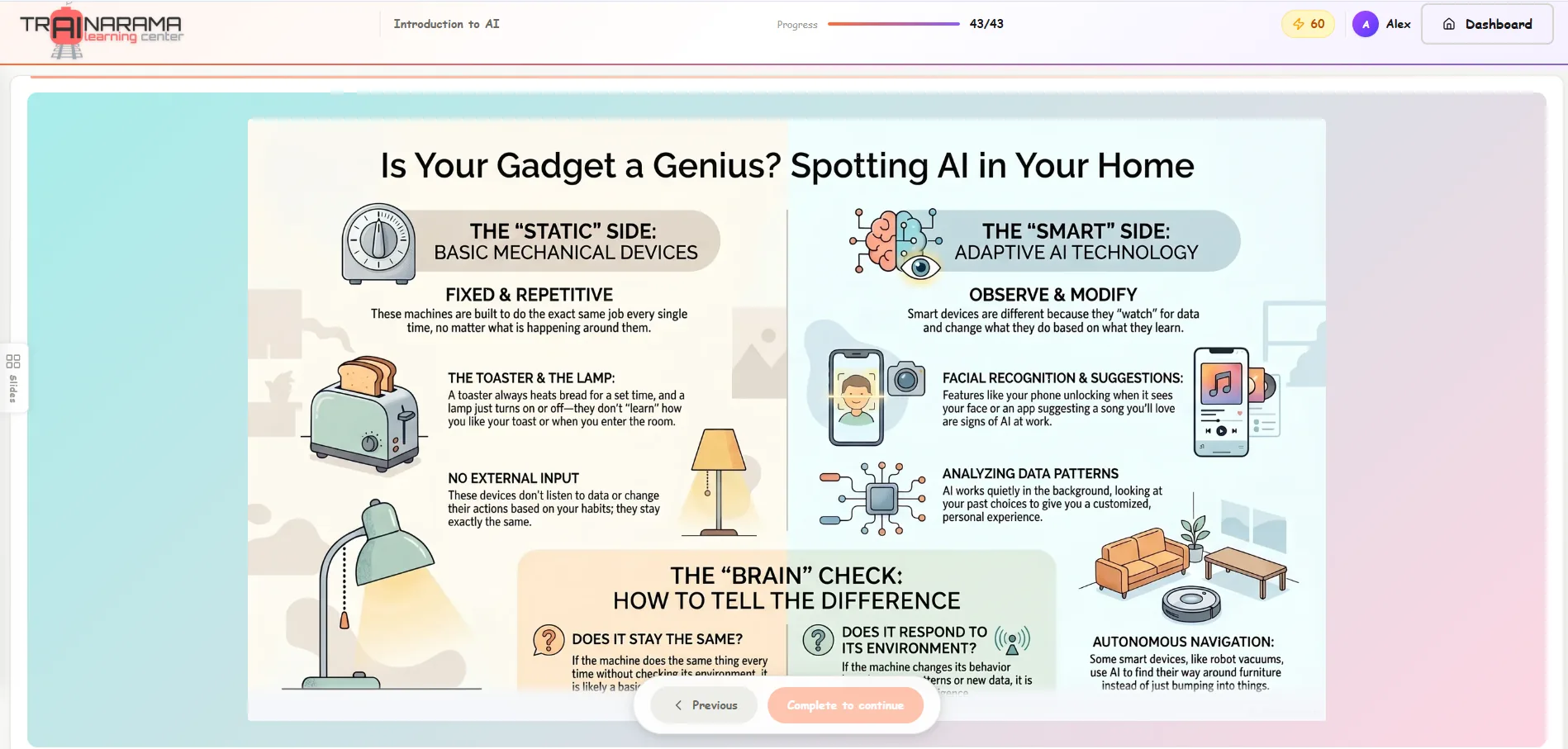
A lesson in progress
A Trainarama lesson in progress, contrasting everyday devices that always behave the same way with ones that adapt.
Concrete things a child already owns, long before any jargon.
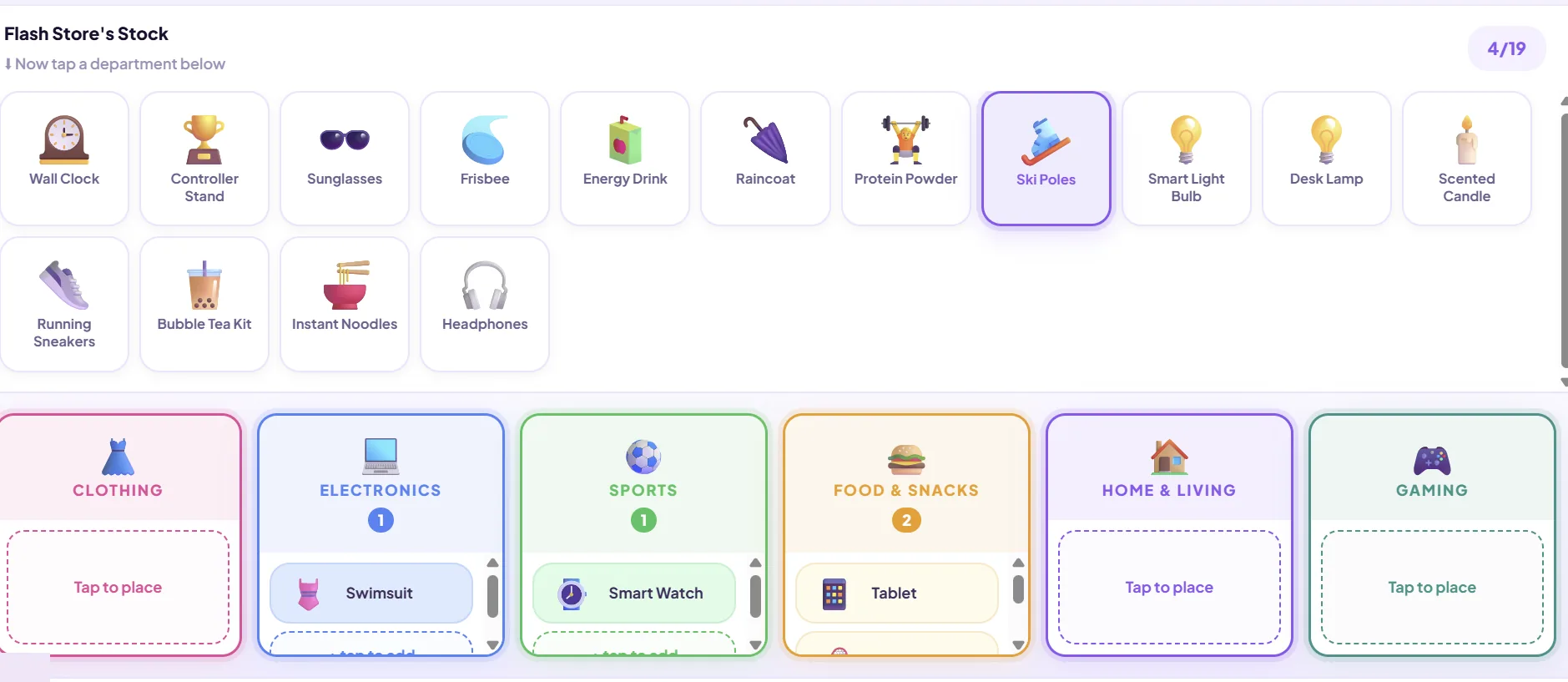
A session, on screen
A Trainarama session on screen: a child sorts products into store departments while an AI assistant handles the rest.
A session as your child sees it.

Sources

  1. 1.Lee, H.-P. et al. (2025). The impact of generative AI on critical thinking. Proceedings of CHI ’25. doi.org/10.1145/3706598.3713778
  2. 2.Bastani, H. et al. (2025). Generative AI without guardrails can harm learning: Evidence from high school mathematics. PNAS, 122(26), e2422633122. doi.org/10.1073/pnas.2422633122
  3. 3.Walters, W. H. & Wilder, E. I. (2023). Fabrication and errors in the bibliographic citations generated by ChatGPT. Scientific Reports, 13, 14045. doi.org/10.1038/s41598-023-41032-5
  4. 4.Parasuraman, R. & Riley, V. (1997). Humans and automation: Use, misuse, disuse, abuse. Human Factors, 39(2), 230–253. doi.org/10.1518/001872097778543886